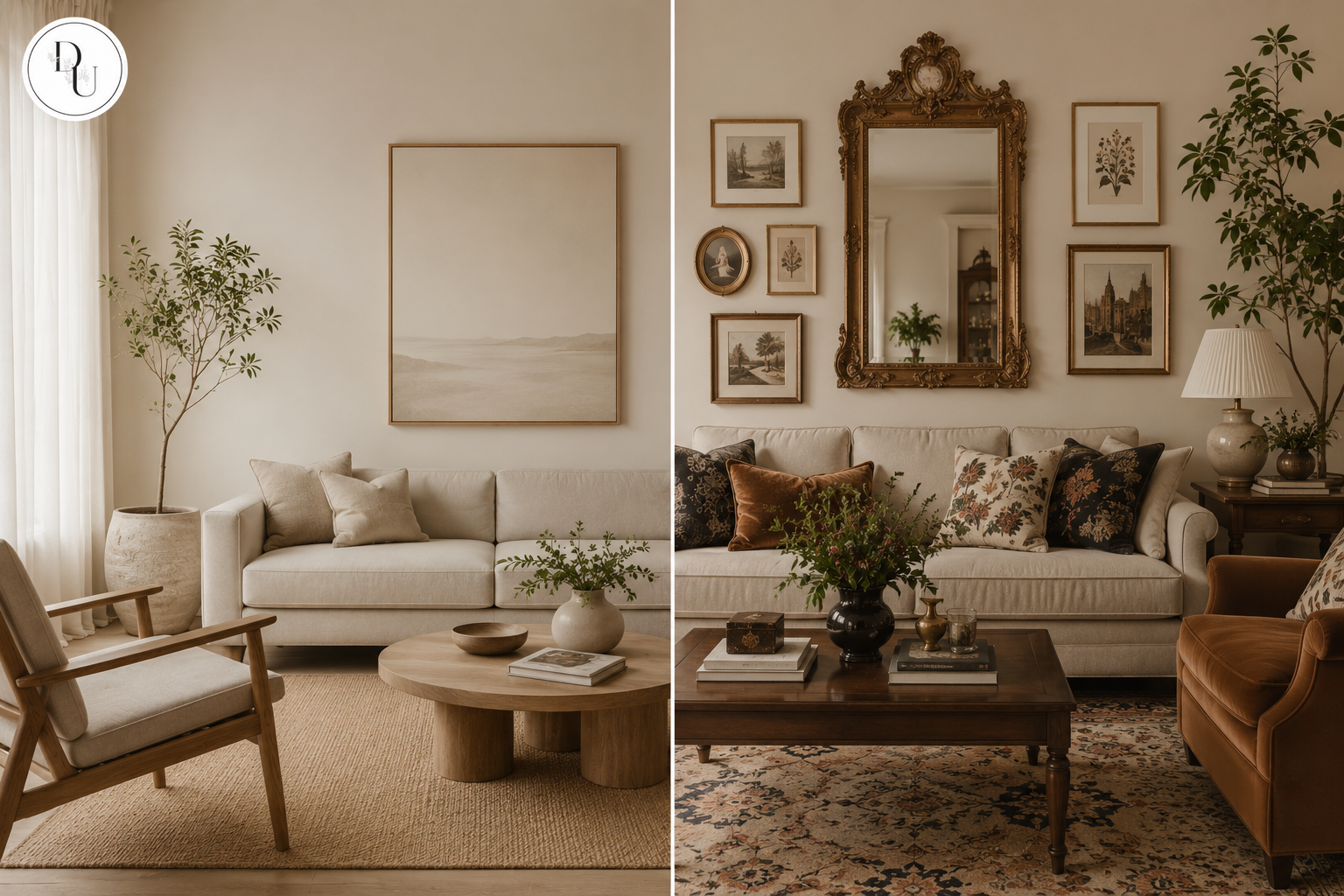
There are two types of people.
Walk into one person’s home and you’ll find bare white walls, furniture that seems to float, negative space treated like a luxury. Walk into another’s and every surface is alive stacked books, layered rugs, a gallery wall that’s half art, half autobiography. Both owners will tell you, with complete sincerity, that their home feels exactly like them.
That’s not a contradiction. That’s the whole point.
Minimalism and maximalism aren’t really about stuff. They’re about identity, how we understand ourselves, what we want our lives to feel like, and which version of “home” makes us exhale when we walk through the door. And right now, in a world that simultaneously overwhelms us with things and tells us to want more of them, the tension between these two ways of living has never felt more personal or more relevant for architects and designers building for real Indian homes.
What is Minimalism in Interior Design?
Minimalism arrived in the cultural mainstream on a wave of collective exhaustion. Clean lines. Neutral palettes. Deliberate emptiness.
The philosophy has older, deeper roots in the Japanese concept of ma, which treats negative space not as absence but as presence. Scandinavian hygge. The Bauhaus principle that form should serve function. But what made it click for millions of people wasn’t philosophy. It was the feeling. Walk into a truly minimalist room and something in your nervous system unclenches.
At its core, minimalist design operates on three principles:
- Subtraction over addition — every element must earn its place
- Material honesty — raw concrete, unfinished wood, exposed steel
- Spatial breathing room — generous proportions, controlled density
For Indian homes specifically, minimalism offers something quietly radical: in a culture where “more” is often equated with prosperity and hospitality, choosing less is a deliberate, confident statement.
There’s something almost countercultural about owning less in a world that profits from you wanting more. At its best, minimalism is an act of quiet resistance, a decision to stop letting your possessions define you.
At its worst, though? It becomes its own kind of performance. The perfectly chosen linen sofa. The single architectural lamp. Anti-consumerism dressed up in very expensive consumer goods. The irony is hard to miss and worth calling out honestly.
What is Maximalism in Interior Design?
Maximalism never disappeared. It just waited for the moment when all those white walls started to feel a little lonely.
That moment has arrived. Across design culture from Milan to Mumbai there’s a hunger for spaces that feel inhabited. For colour that doesn’t apologize. For rooms that tell you something about the person who lives in them before they’ve said a word.
The caricature of maximalism is clutter, chaos, hoarding. The reality, when it’s done with love and intention, is completely different. It’s the living room assembled over decades by the Rajasthani dhurrie next to the mid-century chair next to the shelf of inherited brass. It’s evidence of a life actually lived, not staged.
Good maximalism operates on its own principles:
- Layering with intention — patterns, textures, and eras in deliberate conversation
- Emotional curation — objects chosen for meaning, not just aesthetics
- Controlled abundance — full without being frantic
There’s a profound generosity to a maximalist home. It says: come in, sit anywhere, let me show you what I love. It asks nothing of you except your presence.
And here’s something worth sitting with: in an age of flat-pack furniture and interchangeable aesthetics, the person who holds onto worn things, mismatched things, things that carry memory might actually be the one living more sustainably and honestly. Maximalism, at its roots, is anti-throwaway culture.
Minimalism vs. Maximalism: A Design Comparison
Understanding the two philosophies side by side helps designers make intentional choices for each project:
| Design Element | Minimalism | Maximalism |
| Colour Palette | Neutral, monochromatic | Bold, layered, eclectic |
| Furniture | Few key pieces, clean silhouettes | Mix of eras, collected over time |
| Surfaces | Clear, uncluttered | Books, art, objects, texture |
| Lighting | Architectural, singular | Multiple sources, decorative |
| Brand Feel | Premium, serene, precise | Warm, personal, expressive |
| Emotional Response | Calm, focused | Joyful, immersive, storytelling |
| Best Suited For | Urban apartments, studios, workspaces | Family homes, creative studios, heritage properties |
What This Is Really About
Underneath the aesthetics, the minimalism-maximalism debate is about some very human tensions that every designer eventually confronts.
Order vs. Accepted Chaos Minimalism is partly a fantasy of controlling the belief that if the environment is calm, the mind will follow. Maximalism accepts that a certain beautiful chaos is part of a life fully lived. Both are understandable responses to modern overwhelm. Neither is wrong.
Privacy vs. Openness A maximalist home introduces you to its owner immediately. A minimalist home holds back. One is an open hand; the other is a quiet boundary. For Indian homes where guests arrive frequently and uninvited, this dimension carries particular weight. How much of yourself do you want your space to reveal?
The New vs. The Accumulated Minimalism favours clean slates and fresh starts. Maximalism layers time mixing eras, carrying things forward, refusing to throw away what still holds meaning. There’s something quietly moving about that refusal. For families with heirlooms, inherited furniture, and multi-generational objects, maximalism isn’t a style choice. It’s a form of respect.
The Rise of Hybrid Design: Where India Naturally Lives
Here’s what no one tells you: most people don’t actually live at either extreme. Real homes are compromises. They evolve. You might have a spare, meditative bedroom and a bookshelf that’s threatening to become a second room.
And in the Indian context, this hybrid is almost culturally inevitable. The mother’s brass puja items next to the IKEA shelf. The marble flooring (a generational investment) against a feature wall with bold hand-painted kalamkari. The Mughal arch detail in a contemporary open-plan kitchen.
Some designers call this “edited maximalism” full without frantic, layered but intentional. Others call it “warm minimalism” restrained but not cold, structured but humanised by texture and imperfection. Both phrases are really just ways of saying the same thing: design that starts with how you actually want to feel.
The Japandi trend that swept global interiors, a fusion of Japanese minimalism and Scandinavian warmth found a natural Indian cousin in styles that pair clean architecture with handcrafted, tactile objects. Our craft traditions are maximalist by nature. Our increasingly urban living situations push toward minimalism. The interesting design work happens in the negotiation between these forces.
For Architects and Designers: Choosing the Right Approach
The choice between minimalism and maximalism should never be based on personal taste alone or on trend cycles. It should be driven by:
Who is the client, really? A single professional in a Mumbai high-rise has different spatial and psychological needs than a three-generation joint family in a Jaipur haveli. Understand life before designing the space.
What does the architecture want? Heritage structures often resist minimalism; their walls, proportions, and history demand acknowledgement. New construction on a tight urban footprint often demands it. Let the bones of the building guide the aesthetic.
What’s the sustainability argument? Minimalism supports longevity when done well with fewer, better pieces that aren’t replaced seasonally. Maximalism supports emotional durability, objects with meaning aren’t thrown away. Both, at their principled best, are arguments against disposable design. That’s worth articulating to clients.
What’s the maintenance reality? In Indian homes with dust, humidity, and frequent guests, an all-white minimalist space requires a very specific lifestyle to maintain. A richly layered maximalist space may actually age more gracefully and forgive daily life better. This is a practical conversation designers rarely have honestly enough.
The Only Rule That Matters
Here’s the frustratingly simple truth: the best home is the one that feels like you.
If bare walls make you feel like you’re waiting for an appointment, fill them. If owning things starts to feel like being owned by them, let them go. Neither instinct needs defending and neither needs a design trend to validate it.
For designers and architects, the job is to resist imposing a philosophy and instead to draw out the client’s own instinct then give it form, proportion, and craft. Whether it means one perfect chair in a quiet room, or three generations of mismatched furniture and a wall of framed memories the space should feel, above all else, like somewhere a person actually wants to come home to.
The most enduring interiors aren’t the ones that follow trends. They’re the ones that follow their inhabitants.
And that, ultimately, is the whole conversation.
Design Unfiltered covers architecture, interiors, and design culture across India with a particular focus on Tier-2 and Tier-3 city projects, regional architects, and the intersection of contemporary practice and craft heritage.
Frequently Asked Questions
What is the main difference between minimalism and maximalism in interior design?
Minimalism prioritises space, function, and restraint: fewer objects, neutral tones, clean lines. Maximalism celebrates abundance, layering, and self-expression through bold colour, pattern, and collected objects. The core difference is not aesthetic but philosophical: one edits life down; the other accumulates it.
Which design style is better for small Indian apartments?
Neither is universally better. Minimalism creates the illusion of space and reduces visual noise practical for compact urban homes. Warm maximalism with careful zoning can make a small space feel intimate and personal rather than cramped. The answer depends on how the resident wants to feel, not on square footage alone.
Can minimalism and maximalism coexist in the same home?
Yes and most successful homes do exactly this. A calm, stripped-back bedroom paired with a maximalist living room full of books and art is not a contradiction. It’s a thoughtful response to how different rooms serve different emotional needs.