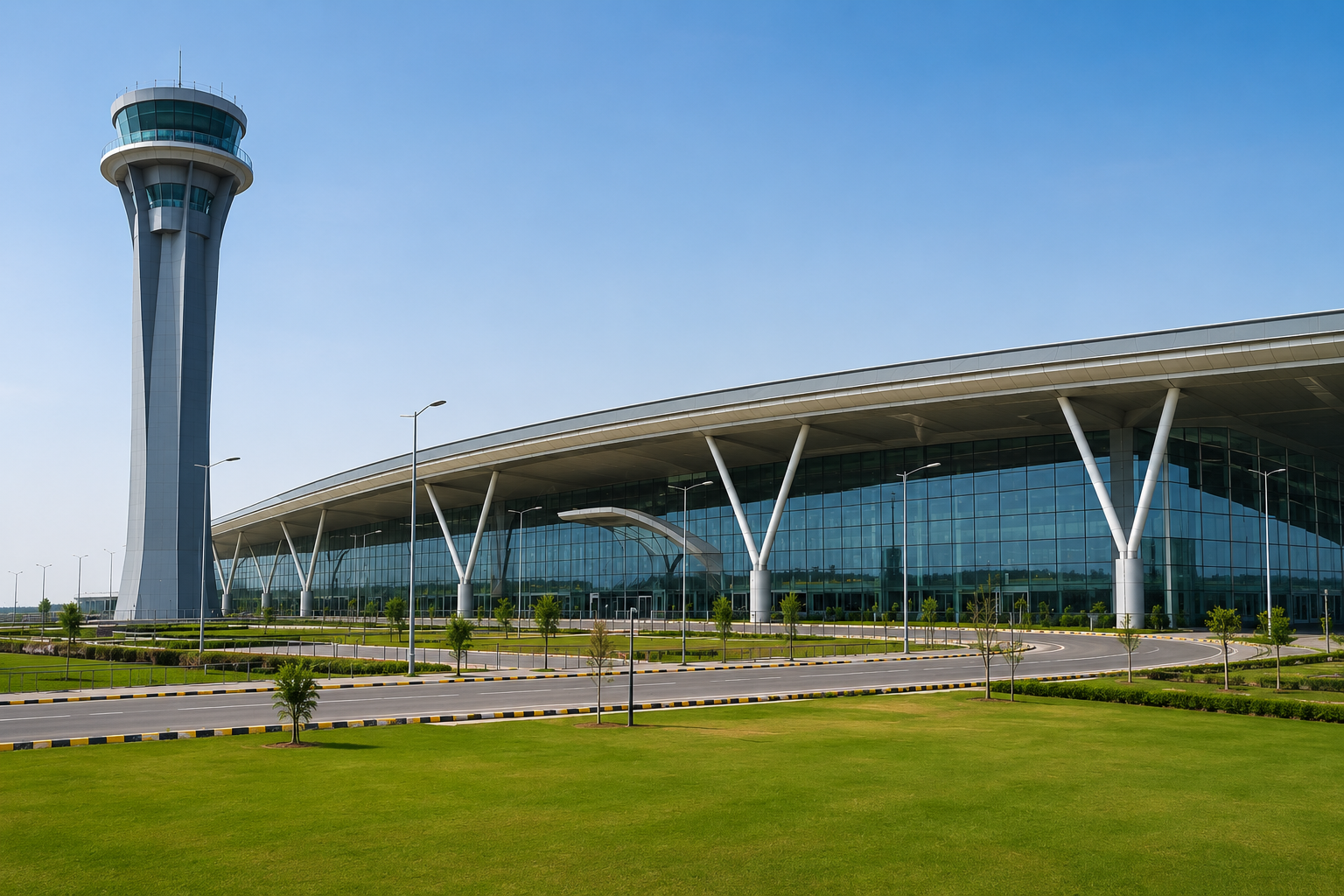
Noida International Airport (IATA: DXN), also called Jewar Airport, launched its first commercial flight on 15 June 2026. The inaugural flight was operated by IndiGo, arriving from Lucknow and landing at the airport in the morning. The airport’s foundation stone was laid by PM Narendra Modi on 25 November 2021, and Phase 1 was formally inaugurated on 28 March 2026 about 4.5 years after construction began. The total Phase 1 budget is approximately ₹11,200 crore (~$1.3 billion USD). It is India’s first net-zero emissions airport, designed by an international team of architects including Grimshaw, Haptic, and Nordic Office of Architecture, using red-tone GRC panels, translucent glass roofing, and sustainable low-emission materials.
India’s Second Delhi-NCR Airport Just Made History
For years, it was the airport India kept talking about but never quite opened. Multiple deadlines came and went. Then, quietly but definitively, on 15 June 2026, an IndiGo aircraft touched down at Noida International Airport and everything changed.
This isn’t just a story about aviation. It’s a story about how architecture, engineering, sustainability, and cultural identity can come together to build something genuinely remarkable. At Design Unfiltered, we exist to spotlight exactly this kind of work and Noida International Airport deserves every bit of attention.
Here’s the full story: the first flight, the numbers, the building itself, and why this airport is a blueprint for the future of Indian infrastructure.
The First Flight: Who, When, Where, and What Time?
Let’s start with what everyone is searching for.
The first commercial flight at Noida International Airport (DXN) operated on 15 June 2026.
It was an IndiGo flight arriving from Lucknow making IndiGo the inaugural carrier at Asia’s newest major aviation hub. After landing on the morning of June 15, that same aircraft then operated the airport’s first outbound flight to Bengaluru.
IndiGo had announced on June 12 that it would launch commercial services from the airport from June 15, formally becoming the first airline to operate from DXN. The airline initially connected the airport to five domestic routes.
Akasa Air joined the following day, on 16 June 2026, adding two more routes to the network.
The airport’s official IATA code is DXN, and its ICAO code is VIND. It is operated by Yamuna International Airport Private Limited (YIAPL), a subsidiary of Switzerland’s Zurich Airport International AG.
As of now, international flights are expected to begin around September 2026, with the same carriers scaling up their schedules.
The Foundation Stone to First Flight: A Timeline
Understanding this airport means understanding its journey. Here’s the clean, factual version:
- 2014 The Jewar airport project is revived and moved back to its current location.
- June 2015 Union Government grants formal approval.
- May 2018 Ministry of Civil Aviation grants in-principle approval.
- October 2020 Final concession agreement signed between NIAL and Zurich Airport International AG.
- February 2021 Airports Authority of India approves the master plan.
- 25 November 2021 PM Narendra Modi lays the foundation stone at Jewar, Gautam Buddha Nagar, Uttar Pradesh. Construction formally begins.
- June 2022 Tata Projects Limited wins the civil construction tender.
- December 2024 First validation/calibration flight successfully completed to test navigational systems, runway lighting, and ATC readiness.
- 28 March 2026 PM Modi formally inaugurates Phase 1 of Noida International Airport. He also lays the foundation stone of 40 acres of Maintenance, Repair and Overhaul (MRO) facilities.
- 15 June 2026 First commercial flight lands. Noida International Airport is officially open for passengers.
From foundation stone to first flight: approximately 4 years and 7 months.
The Numbers: Budget, Scale, and Capacity
Architecture is never just aesthetic — it’s economics too. Here’s what went into building Phase 1:
| Detail | Fact |
| Total Phase 1 Investment | ₹11,200 crore (~$1.3 billion) |
| Land Area (Phase 1) | 1,334 hectares |
| Runway Length | 3,900 metres (CAT III-B standard) |
| Terminal Size | 1,01,590 sq metres (approx. 1 lakh sq m) |
| Phase 1 Passenger Capacity | 12 million per year |
| Ultimate Capacity (by 2050) | 70 million per year |
| Number of Runways at Full Build | 6 |
| Developer | Yamuna International Airport Pvt Ltd (Zurich Airport subsidiary) |
| Civil Constructor | Tata Projects Limited |
| User Development Fee (Domestic) | (Domestic)₹490 per departing passenger |
The airport is structured as a Public-Private Partnership (PPP). NIAL the joint venture holds the government stake, with the UP Government at 37.5%, Noida at 37.5%, Greater Noida at 12.5%, and YEIDA at 12.5%. Zurich Airport International AG is the private concessionaire.
The Architecture: This Is Where It Gets Interesting
For readers of Design Unfiltered, this is the heart of the story.
Noida International Airport’s terminal was designed by an international joint venture: Grimshaw Architects (UK), Haptic Architects (UK/Norway), and Nordic Office of Architecture (Norway). They were selected by YIAPL to develop the design from concept through to EPC tender.
The brief was one of the most thoughtful in recent Indian infrastructure history: merge Swiss efficiency with Indian hospitality. The result is a building that feels genuinely rooted in place.
What Materials Were Used?
GRC (Glass Reinforced Concrete) in red tones: The west-facing façade features deep vertical fins made from red-tone GRC, directly echoing the red sandstone and traditional jaali screens of the surrounding Uttar Pradesh region. This wasn’t a decorative choice, it’s a passive solar strategy that reduces solar heat gain on the most sun-exposed face of the building.
Glass strategic and directional: The northern façades are fully glazed to maximise natural daylight and offer views to the runway. The southern façades use horizontal overhangs and louvres. The approach reduces solar exposure across the building by 60–70% compared to a standard all-glass box.
Translucent, wavy white roofing: Inspired by the rivers of the Yamuna region, the roof undulates like a flowing water body, allowing diffused light to enter the terminal without harsh glare.
Low-emission interior furniture and finishes: Over 6,000 custom-designed furniture elements were installed throughout the terminal, all selected for low volatile organic compound (VOC) emissions, responsibly sourced materials, and durability. This is one of the largest sustainable furniture deployments in an airport globally.
What Makes the Design Special?
The terminal takes cultural cues from multiple sources and handles them with restraint rather than pastiche:
Jaali screens: Ornamental lattice panels inspired by traditional Indian jaali work appear throughout the terminal.
Ghats of Varanasi: The terminal forecourt features stepped architecture echoing the famous river ghats of Varanasi and Haridwar.
Haveli courtyard: A central courtyard inside the terminal allows fresh air and natural daylight to penetrate deep into the building, mimicking the logic of a traditional haveli. This isn’t just aesthetic, it reduces mechanical ventilation demand.
Biophilia: Lush greenery is integrated into internal and external spaces, reducing heat island effect and improving passenger experience.
The result is a terminal that Klaus Bode of Urban Systems Design described as one that “defines a new genre in airport design by truly interweaving local Indian culture, lessons learned from the past and inspired by vernacular architecture, with environmental design and digital technology.”
More: https://designunfiltered.com/
India’s First Net-Zero Emissions Airport
This is the claim that sets Noida International Airport apart from every other airport in India and most airports in Asia.
The terminal is designed to achieve IGBC New Building Platinum certification, India’s highest green building rating. It targets net-zero energy consumption in operation, using passive design (reducing demand) before adding renewable energy systems.
Key sustainable design strategies include: maximising natural daylight to cut artificial lighting loads, using the courtyard for natural ventilation, specifying low-carbon construction materials, integrating building-wide energy management systems, minimising water consumption through efficient fixtures and on-site water recycling, and using eco-friendly, low-emission furniture throughout.
This is an airport designed not just to move people but to do so without moving the climate.
Why This Matters Beyond Aviation
Noida International Airport is built to serve western Uttar Pradesh, a region covering Noida, Greater Noida, Ghaziabad, Agra, Mathura, Aligarh, Etawah, and Faridabad. These are cities that previously had no practical airport of their own. Residents of Greater Noida, for instance, spent up to 110 minutes navigating traffic just to reach IGI Terminal 3.
The airport also reduces congestion at Indira Gandhi International Airport, currently one of the most over-capacity airports in the world.
Once fully developed across four phases, NIA is projected to become Asia’s largest airport, handling 60–70 million passengers per year potentially making it the fourth largest airport in the world.
A metro line connecting the airport to Greater Noida and central Delhi is planned. A high-speed rail link and dedicated expressway corridor are also in progress.
For Architects: What Noida Airport Teaches Us
At Design Unfiltered, we cover architecture not just as spectacle but as a professional conversation. Here’s what this project offers practitioners:
Passive design first. The team at Grimshaw and Urban Systems Design made energy reduction the primary design driver not the aesthetic. Every material and orientation choice was made with solar exposure in mind. The aesthetic emerged from those constraints, not despite them.
Vernacular as structure, not decoration. The red-tone GRC fins work because they solve a real problem (solar heat gain) while referencing a real material culture (red sandstone). Using traditional motifs to solve technical problems is very different from applying them as surface decoration.
Scale demands humility. A terminal for 12 million passengers per year is not a building to be eccentric with. The design team chose clarity, legibility, and warmth qualities that work at human scale even inside a massive structure.
Net-zero is a design brief, not an add-on. The sustainability targets at NIA were set before the architects were selected. This is the model for how India must build from here forward.