There are homes you visit. And then there are homes that visit you long after you have left — settling somewhere behind the eyes, quietly insisting to be remembered. Jagdamba Haveli, nestled in the sun-baked landscape of Rajasthan, belongs firmly to the second kind.
Named after Jagdamba — one of the most revered forms of the divine mother in Indian tradition — this haveli is far more than an architectural achievement. It is a living philosophy. A built prayer. A space where the ancient and the contemporary do not compete, but instead lean into each other with quiet confidence.
The Name That Shapes the Space
The Name That Shapes the Space
To understand Jagdamba Haveli, you must first understand the name it carries.
Jagdamba, a sacred manifestation of the divine feminine, embodies strength without aggression, protection without severity, and grace without fragility. She is the energy that holds and grounds. And if you spend even an hour inside this haveli, you will feel exactly that — held, grounded, and deeply at ease.
This is not coincidence. The design team drew intentionally from the symbolic weight of the name, letting it shape decisions of material, proportion, light, and atmosphere. Every room in Jagdamba Haveli answers a quiet question: *does this feel like strength and grace together?* If the answer was no, it was reconsidered.
More:- https://designunfiltered.com/daspan-house-boutique-heritage-hotel/
The result is a home that feels both powerful and tender — a balance that is extraordinarily difficult to achieve in architecture, and rarer still in interior design.
Rooted in Rajasthan: Why Location Is Everything Here
Rajasthan does something to design that no other Indian state can quite replicate. The land itself — its ancient stone quarries, its centuries of craftsmanship, its layered history of royal courts and artisan communities — becomes a collaborator. You don’t simply build *in* Rajasthan. You build *with* it.
Jagdamba Haveli leans into this truth completely. The choice to work primarily in natural stone and wood is not merely aesthetic — it is an act of cultural honesty. These are the materials that have defined Rajasthani architecture for centuries, from the golden sandstone of Jaisalmer to the blue-grey Jodhpur stone. Using them here is a form of belonging.
The haveli sits within this landscape not as an imposition but as a continuation — as if the ground itself had decided, after all these centuries, to take one more beautiful form.
Design Philosophy: Understated Luxury, Honestly Expressed
The interior design of Jagdamba Haveli follows what the studio calls an “UnFiltered” approach — a philosophy that resists decoration for decoration’s sake, and instead lets material quality, spatial proportion, and natural light do the heavy lifting.
This is quiet luxury in its truest form. Not quiet because it whispers or hides, but quiet because it has nothing to prove. The spaces do not announce themselves. They simply *are* — and the quality of that existence speaks.
Stone:- is the primary material language of the home. It wraps walls and floors in warmth, adding texture that catches light differently at each hour of the day. In the morning, the stone feels golden and soft. By afternoon, it holds the heat of the sun with calm authority. At dusk, it deepens into something almost amber — rich and ancient and entirely at home in itself.
Wood:-arrives as counterpoint — softer, more intimate, appearing in joinery, furniture frames, ceiling details, and doorways. Where stone gives the haveli its bones, wood gives it its warmth. Together, they create an interior that breathes.
What is notable about the material choices here is their restraint. There is no marble for the sake of opulence, no gilding for the sake of grandeur. Every surface earns its place by what it contributes to the experience of the room — not by what it signals about budget.
Moving Through the Rooms: An Experience of Stillness
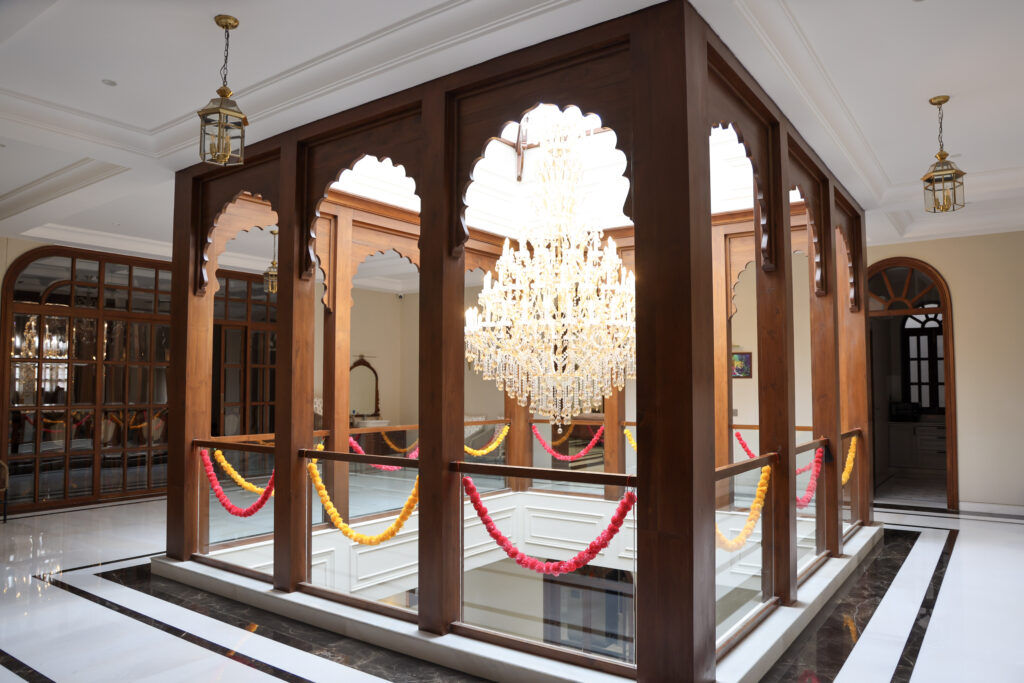
The Living Area: The living space opens upward — literally. A soaring double-height volume draws the eye skyward where a chandelier hangs not as decoration but as architecture, catching and distributing light across the stone surfaces below. The effect is one of unexpected openness: you feel the sky even when you cannot see it.
Furniture is composed with the kind of care typically reserved for exhibition spaces. Each sofa, chair, and table occupies its position as if it had found its way there naturally, yet nothing is accidental. Scale and proportion are governed by a steady hand — large enough to feel generous, precise enough to never feel overwhelming.
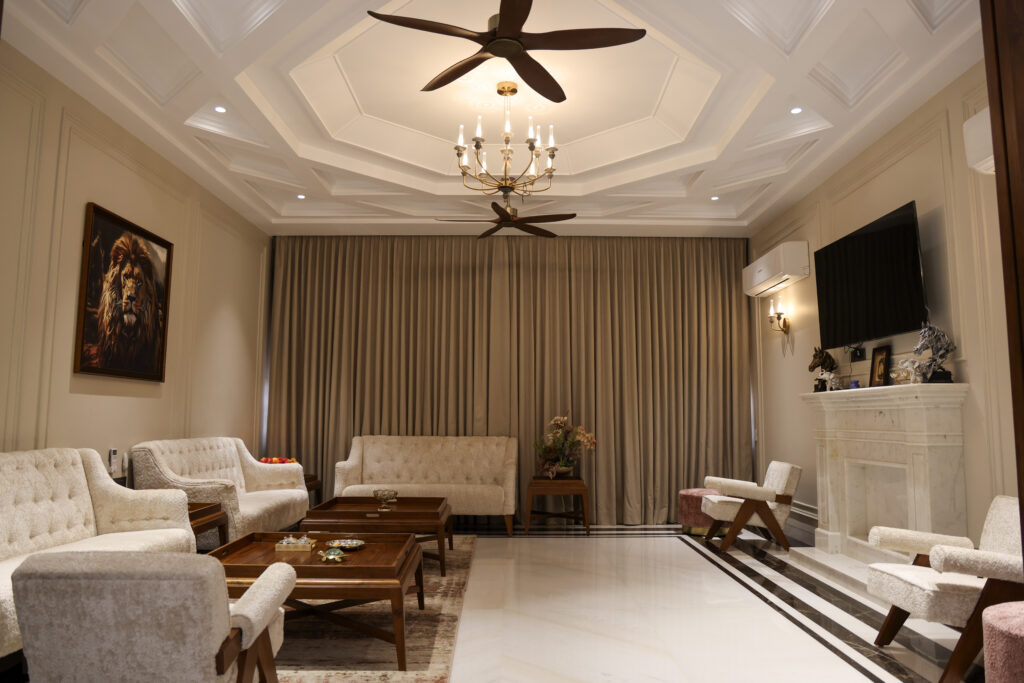
The Drawing Room: Flowing from the living area, the drawing room slows things down further. A fireplace anchors the space with an authority that fireplaces uniquely possess — there is something deeply human about gathering around heat and light, and the designers have honored this instinct without sentimentality.
Artworks on the walls interact with the furnishings in the manner of a carefully considered conversation rather than a decorative statement. The lighting is calibrated to create depth — some corners warmer, some cooler — so the room has texture in its illumination, not just in its materials.
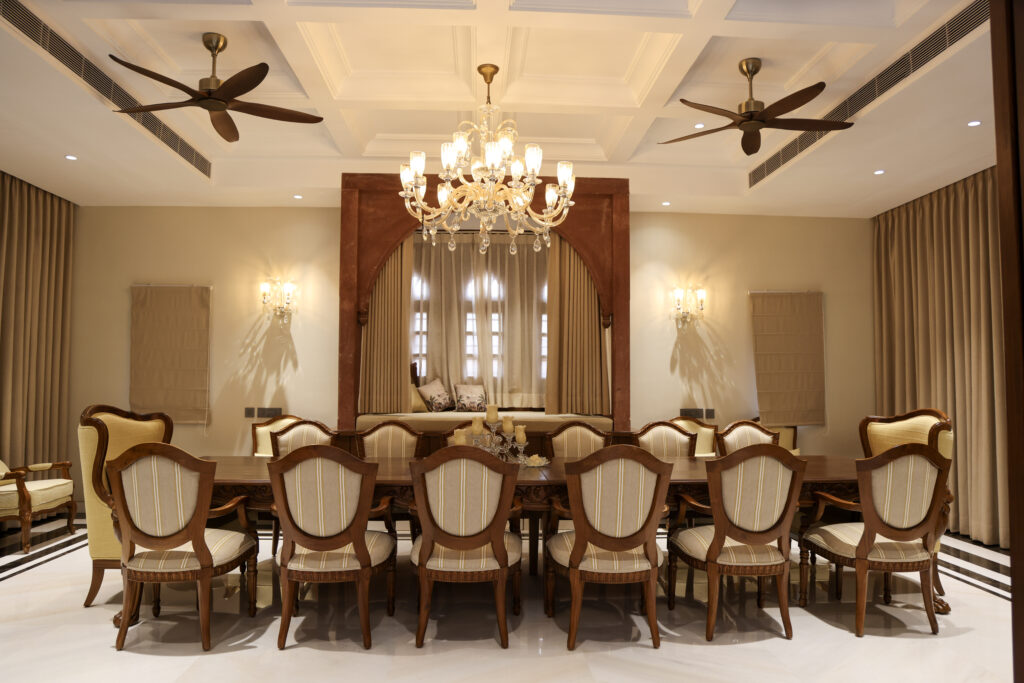
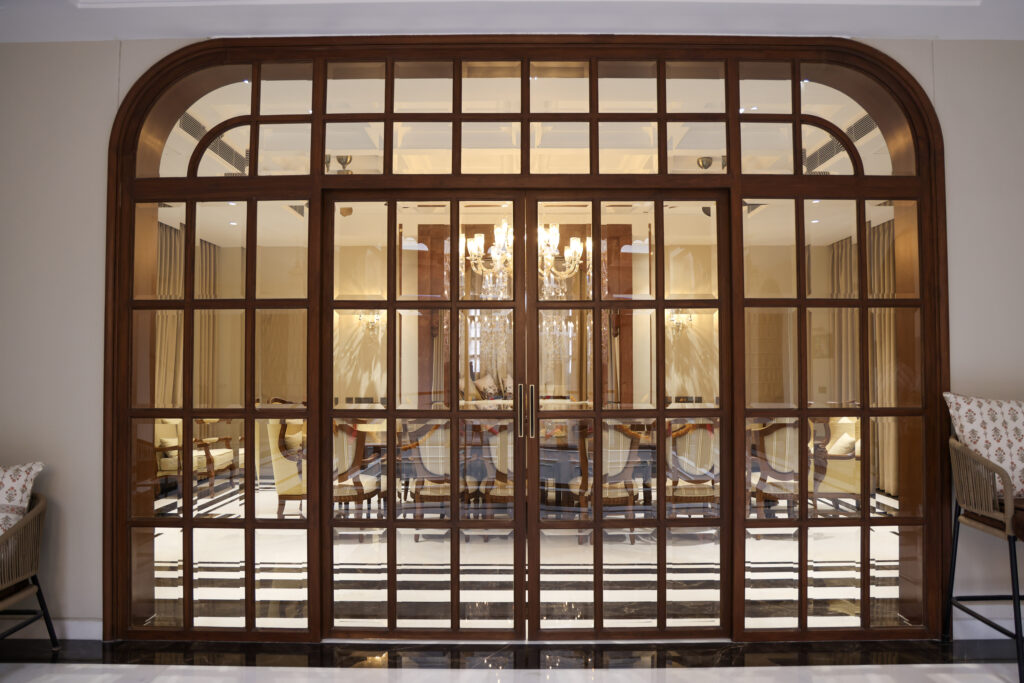
The Dining Area: Light enters the dining room through *jharokhas* — the ornate projecting windows that are among the most iconic elements of Rajasthani architecture. These carved openings do not simply admit daylight; they *sculpt* it, breaking it into patterns that shift across the stone floors and table surfaces throughout the day.
Eating here becomes a slower, more conscious act. The light and texture of the room invite you to notice your surroundings, to be present — a rare gift in contemporary design.
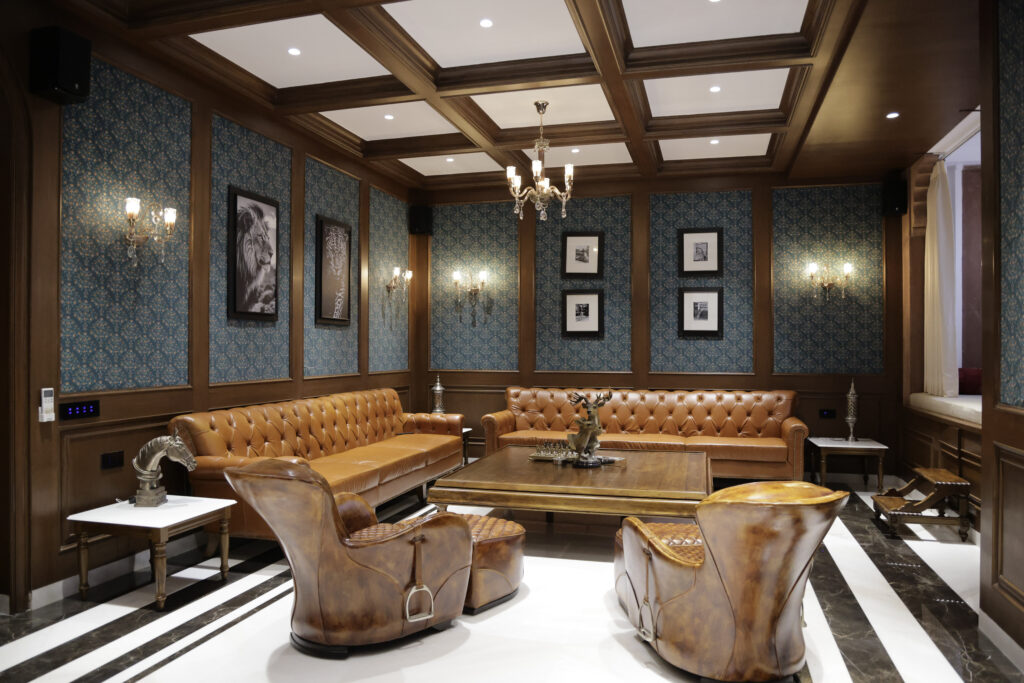
The Bar: The bar is designed as the most intimate space in the home — a retreat within a retreat. Soft lighting plays against stone surfaces that absorb and return warmth in equal measure. Upholstered seating in rich, earthy tones invites the kind of long, unhurried conversation that becomes the unofficial purpose of every great bar.
There is a suggestion of music here, even in silence. The acoustic quality of the stone, the low ceiling, the close arrangement of seating — it all conspires toward connection, toward ease.
Heritage Meets the Present: How Jagdamba Haveli Bridges Two Worlds
What makes Jagdamba Haveli genuinely significant in the landscape of contemporary Indian interior design is not that it revives heritage — many projects attempt that. It is that it does not treat heritage as a costume.
The traditional elements — jharokhas, stone masonry, carved woodwork, the haveli’s spatial typology itself — are not applied to a modern box as decoration. They are structural. They determine how light enters, how air moves, how rooms relate to each other. The traditional and the contemporary are inseparable here because they were never treated as opposites.
This is the UnFiltered approach made visible: no filtration, no mediation, no apology. Just the best of what this land, this culture, and this moment have to offer — composed together with intelligence, craft, and genuine care.
Why Jagdamba Haveli Matters
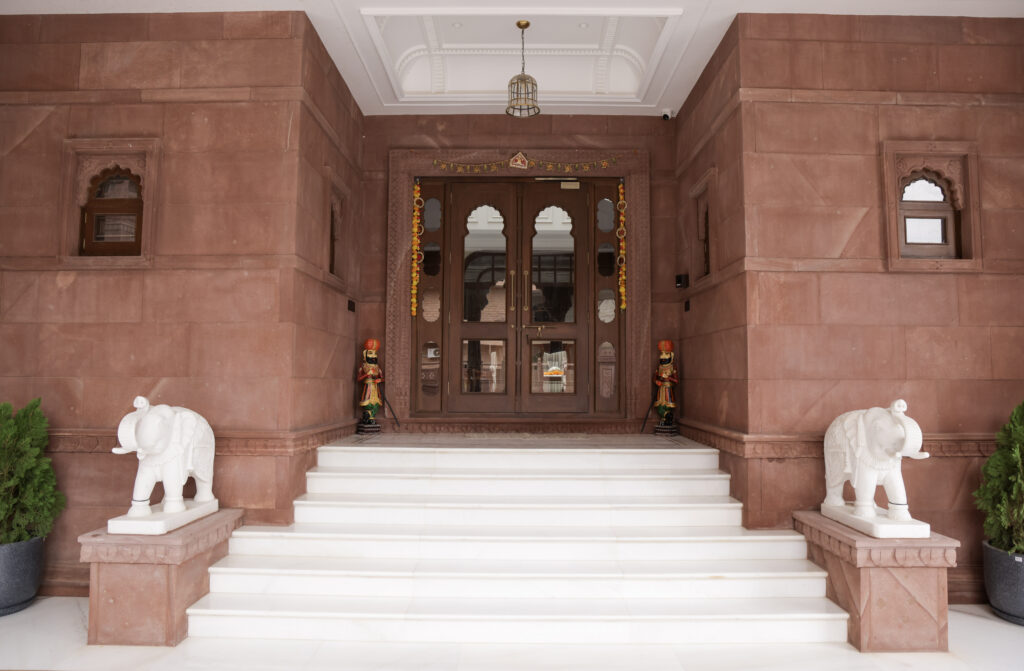
At a time when design culture globally is reckoning with questions of authenticity, sustainability, and cultural rootedness, Jagdamba Haveli offers a quietly radical answer. It suggests that the most forward-looking thing a designer can do is listen deeply to where they are — to the land, to the history, to the name of the goddess carved into the very idea of the building.
The result is a home that will age with extraordinary grace. Because it was never chasing a trend, it has no trend to fall behind. It belongs to Rajasthan, to Indian heritage, to the timeless vocabulary of stone and wood and light. And in that belonging, it achieves something permanent.
Frequently Asked Questions (FAQs)
Q1. What makes Jagdamba Haveli different from other luxury interior design projects in Rajasthan?
Jagdamba Haveli stands apart because its design philosophy is rooted in the *meaning* of the space, not just its aesthetics. The name Jagdamba — a divine form of the Indian mother goddess — shapes the atmosphere intentionally, resulting in interiors that feel both spiritually grounded and luxuriously livable. Unlike projects that apply Rajasthani elements decoratively, Jagdamba Haveli treats heritage features like jharokha windows and natural stone as structural and experiential, not ornamental.
Q2. What interior design style is used in Jagdamba Haveli, and how would you describe the aesthetic?
The haveli follows an “UnFiltered” design approach — a philosophy of understated luxury that prioritizes material quality, spatial proportion, and natural light over excessive ornamentation. The style sits at the intersection of contemporary minimalism and Indian heritage: clean lines and quiet spaces informed by traditional Rajasthani materials and architectural elements. Think of it as quiet luxury with a deep cultural soul — refined without being cold, traditional without being nostalgic.
Q3. What traditional Rajasthani architectural elements are featured in Jagdamba Haveli?
The haveli incorporates several defining elements of Rajasthani heritage architecture. Jharokha windows — the projecting carved screens traditional to Rajasthani palaces and havelis — are used in the dining area to sculpt natural light across stone surfaces. Natural stone (the dominant material of Rajasthan’s built heritage) is used throughout as both structure and finish. Handcrafted woodwork features in furniture, joinery, and ceiling details. Together, these elements create an interior vocabulary that is unmistakably rooted in its regional context while remaining entirely contemporary in its spatial sensibility.
Project: Jagdamba Haveli | Location: Rajasthan, India | Design: UnFiltered Design Studio