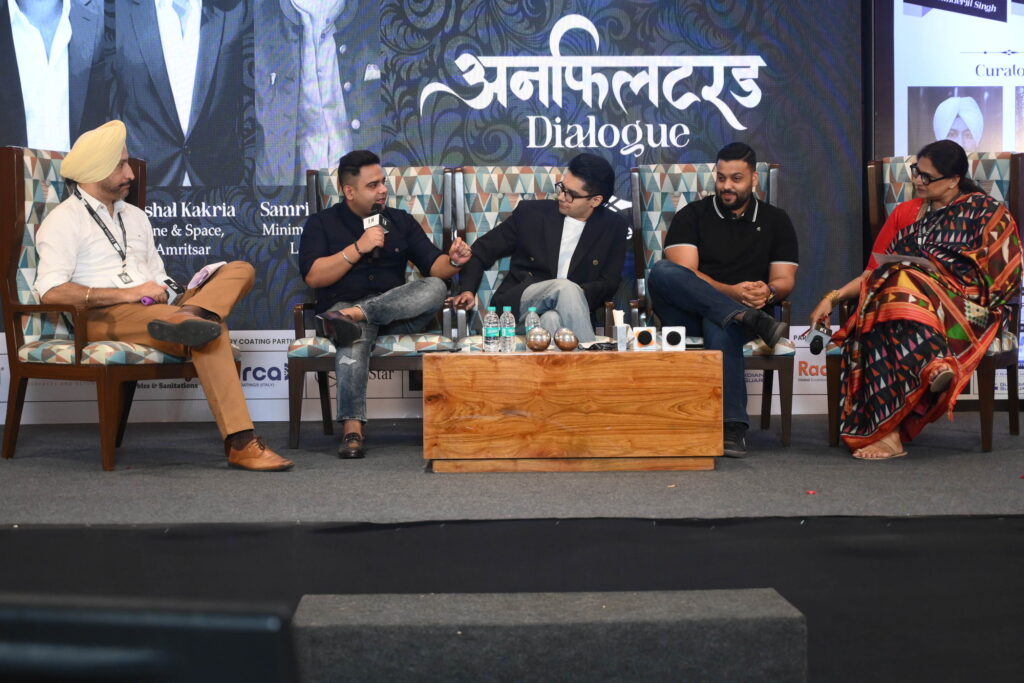
DU Conclave | Radisson Blu | October 2025
Sustainability could be the “buzzword” without a doubt, but luxury is something that isn’t taking the back seat anytime. Related to the statement? Chosen your team? It’s luxury versus sustainability, people. The never-ending debate got hotter at one of our recent Design Unfiltered events held in Amritsar. Fasten your seat belts and sink into this enlightening talk… Let’s go.
As the moderator smartly observed, “We are sitting in an air-conditioned hall discussing sustainability — that itself raises an interesting point.” The remark set the tone for a candid yet nuanced discussion on whether luxury and sustainability are really two spectrums or if they can coexist.
For decades, the two have been regarded as opposites. Luxury has been associated with fineness, while sustainability has been linked to restraint and simplicity.
“I believe in balance — a balance between sustainability and luxury,” said one panelist. “Luxury and sustainability are no longer contradictions”, he opined. This sentiment reflects a growing shift in both architectural thinking and client expectations. Increasingly, homeowners are seeking residences that are not only visually impressive but also environmentally responsible.
The transformation is more evident when compared to earlier times. Recalling her early practice, a panellist quoted, “I used to explain things to clients… But their response would often be, ‘No, madam, the sun stays here all day.’” Today, however, awareness has significantly improved. Clients are asking for rainwater harvesting systems, energy-efficient technologies, and sustainable materials — even when they cost more.
But luxury again is a very subjective concept, we must say. As Ar Harsh explained, “Luxury is a complicated concept because it means different things to different people.” In some contexts, it is about comfort; in others, about display. Yet increasingly, it is being looked at through the lens of performance and environmental sensitivity.
He also went on to explain luxury in terms of design stages. “When we talk about luxury, we often focus on materials used during construction,” he said. But those materials only account for about 15–20% of the environmental impact over the building’s entire life cycle,” added Harsh.
He further quoted that the remaining 60–70% comes from operational costs — energy consumption, air-conditioning, lighting, and maintenance. “So if we truly want to balance luxury and sustainability, the key lies in planning”, said Harsh, summing it up.
The moderator reinforced this with a practical tip: “If we create a south-facing glass façade just for visual appeal, it will increase the building’s air-conditioning load.” Such examples highlight how aesthetic decisions can have lasting environmental consequences. “Therefore, such are the decisions architects must carefully manage,” the moderator opined.
Rather than inhibiting luxury, sustainability should now be seen as a means to complement it. “We must design a future where sustainability becomes the foundation of luxury,” a panelist remarked. Projects that merge greenery, natural light, and along with all those luxe elements clients don’t want missing – is the real deal here. Thankfully, the talk by now has discovered an amicable direction to go in. Luxury + sustainability it was.
The discussion now moved towards Smart Cities. With rapid population growth and increasing pressure on infrastructure, sustainable planning has become imperative. As one expert noted, “Sustainability is needed everywhere — in buildings, infrastructure, and Smart City planning.”
Despite progress, misconceptions still remain. Many still believe sustainable architecture lacks the scope for refinement. Addressing this, a panelist clarified, “Sustainability isn’t just about using mud or exposed bricks. It’s about the techniques and systems we use inside the building.”
For young or perhaps, Gen Z architects navigating a market ruled by conventional luxury, the challenge is real. Yet the panel’s message was unequivocal: “Sustainability is not just a market demand — it is our responsibility as architects.”
The talk concluded on a reflective note. “Society has given us knowledge and opportunity. It is our duty to give something back,” the moderator made a powerful point there.
According to DU, the future of architecture lies not in picking one — luxury or sustainability. It lies in facilitating a beautiful collaboration between the two. And after this talk, we’re so sure that the respected design fraternity comes up with meaningful designs that responsibly bring about a balance between both, creating spaces that are 2050-ready. What do you say?
The event was graced by who’s who of the architecture fraternity of Punjab like Harsh Parmar from Pathankot, Sonaly Mahajan from Jalandhar, Shubham Poply from Ludhiana, Sanjay Goel from Ludhiana and the moderator for the day – Pankaj Chabra from Amritsar.