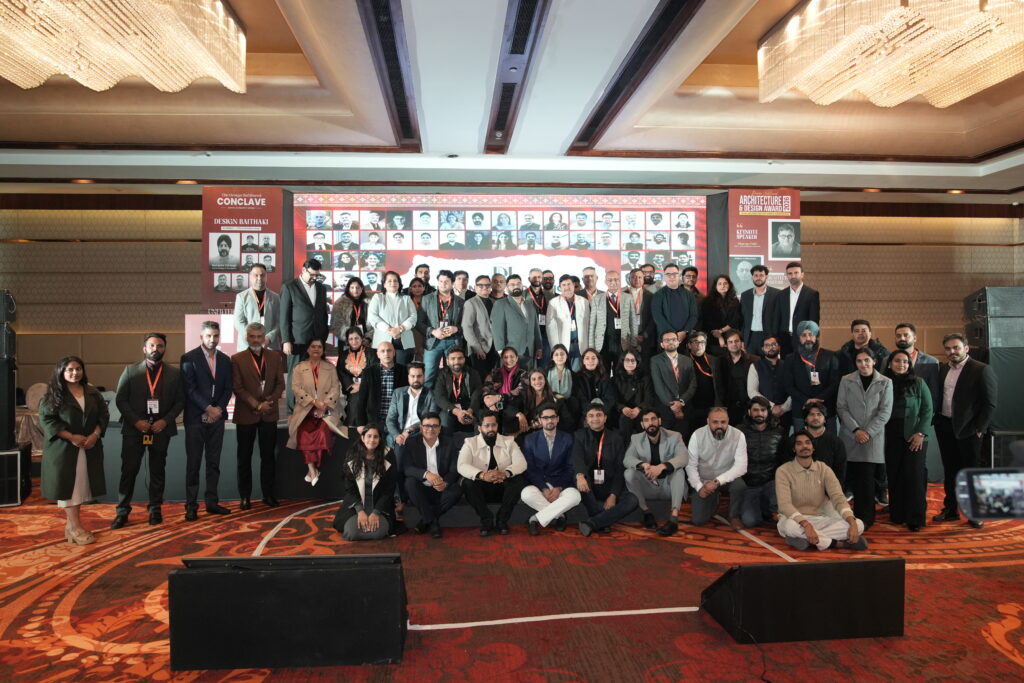
DU Conclaves are slowly becoming “home” for talks that can ignite true conversations – sometimes these debates have topics that have been there for ages. At a recent session hosted by Design Unfiltered, architects came together to examine a fundamental question, and the topic was persistent yet still relevant – detailing versus execution. For the architecture fraternity, the topic could sound mundane. However, the lively discussion fulfilled its purpose by giving the sought clarity.
So… Is architecture defined by what is drawn, or by what is ultimately built?
Moderated by Hersh Parmar, let’s find out what unfolded and how…
DUnFiltered Question: Independent or inseparable!?
From the very start, the panelists seemed to agree that detailing and execution are inseparable.
Arshia Khajooria Hazarika defined architecture to be a process where ideas are shaped through detailing and realized through execution. She supported her statement by quoting examples of two contrasting figures in Indian architecture Nari Gandhi and Anant Raje. She said while Gandhi is known for his intuitive, execution-driven approach, Raje’s drawings were celebrated for their precision. Yet despite their differences, both approaches highlight the same idea that architecture cannot exist without both detailing and execution.
Archana Chibb went on to further extend this argument by emphasizing that detailing begins much earlier than is often assumed. It starts at the very inception of a project, during site analysis. Understanding the site, climate, and context lays the groundwork for all future decisions.
Another panelist, Asma Nisar said that detailing is like sharpening an axe before cutting a tree. She further said that execution is the final step that stitches everything together. The craft and preparation behind the scenes make execution successful.
Overall, the first few minutes of the discussion revealed that the answer lies not in choosing one over the other, but in understanding the balance between the two.
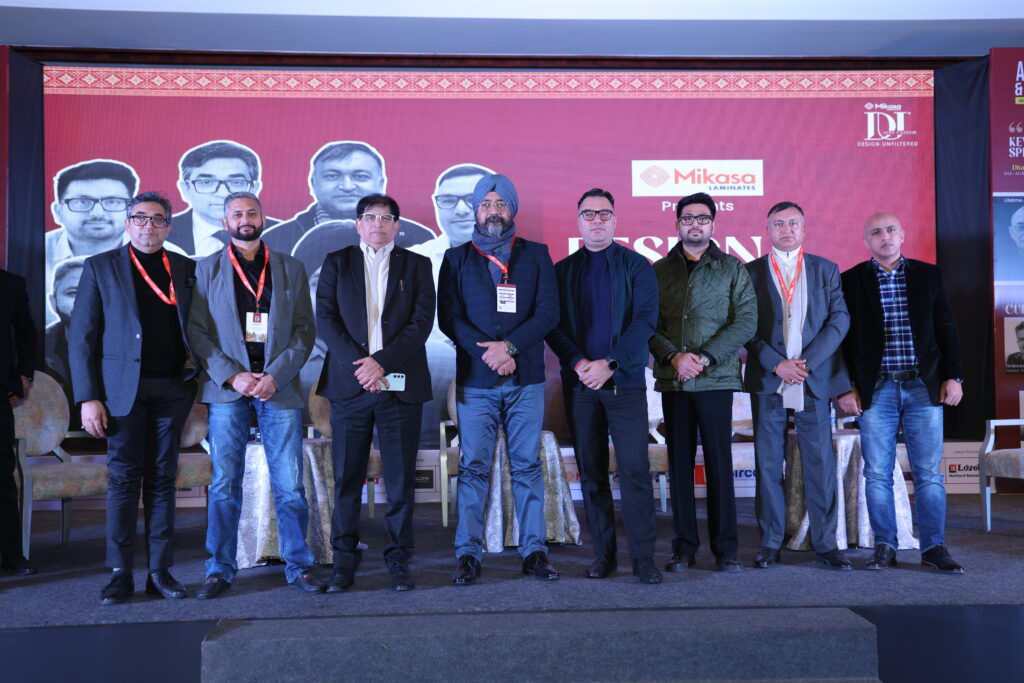
DUnFiltered Question: Idea Versus Reality. The winner?
The talk intensified when it came to understanding the gap between concept and construction. It emerged as a central theme of the talk, in fact.
Hemani Badyal pointed out that even the most detailed design has little value if it cannot be executed effectively. The distance between an idea and a building, she noted, can only be bridged when detailing and execution work together.
Kushagra Anand reinforced this with the phrase, “God is in the details.” He, however, in the same breath said that the details must be translated properly on-site because otherwise, they may only remain theoretical.
Sitting for the talk, panelist Shuaib Mukhtar’s thoughts were sailing a bit differently as he leaned more strongly toward execution. In his view, materials, finishes, and design intent all depend on the quality of workmanship. Poor execution can undermine even the best design.
Lastly, in the session, the moderator highlighted that the balance between detailing and execution varies depending on the project. Ar. Hersh interestingly quoted that while experiential spaces like nightclubs may prioritize atmosphere, residential architecture demands careful detailing because it directly affects daily life.
DUnFiltered Question: Who Owns the Execution?
Now came the time to cater to the elephant in the room – the real question of accountability – who does the execution? It certainly introduced a layer of complexity to the whole talk.
If execution is part of the architect’s scope, should they be responsible for its quality? This sought an answer.
The answer to this, however, can only be a bit nuanced.
No wonder everyone in the panel agrees that while accountability is important, the realities of practice make complete control difficult. Architects often work across multiple projects, limiting their ability to be present on-site at all times. As a result, execution becomes a shared responsibility involving project managers, site engineers, contractors, and sometimes, clients too.
Budget constraints further influence this idea. Smaller projects, which may not have adequate resources for end-to-end supervision, can affect how closely architects can monitor execution.
Arshia Khajooria Hazarika rightly pointed out that scale also plays a crucial role. Larger projects require structured coordination — consultant meetings, work processes, mock-ups — to ensure that the design intent is maintained.
Asma Nisar perfectly summarized all of it by stating that a project is like raising a child. While the architect initiates the vision, many stakeholders contribute to its realisation.
DUnFiltered Question: Detailing – How Much is Too Much?
Phasing out and moving to another section, the talk also tried to understand whether architectural detailing is becoming overly idealized in the country.
While drawings and digital models continue to evolve in precision, construction remains subject to uncertainties. Panelists opined that functional systems—such as structure, plumbing, and electrical layouts—must be resolved early and cannot be compromised.
Aesthetic details, however, often evolve during construction, shaped by site conditions and available skills, they agreed collectively.
For some panelists, detailing is not confined to drawings at all. It begins with the first conceptual move and continues through the user’s experience of space.
DUnFiltered Question: Discussing the Limitations
In India, architecture is deeply influenced by practical limitations like budget, labor skill, and time.
The talk chalked out solutions to these. They said one strategy could be the use of local materials and craftsmanship. This approach can not only manage costs but also carve a contextual path for the project.
Shuaib Mukhtar further stated that simplification is sometimes necessary when skilled labor is unavailable. For this, architects should design with an awareness of what can realistically be executed.
However, the panel later emphasized that constraints do not always limit quality. With proper supervision and clear communication, even complex designs can be successfully realized.
In the end, Asma Nisar highlighted the importance of worker training. She said that many execution issues arise from a lack of technical understanding rather than design flaws.
DUnFiltered Question: Architectural Loopholes or an Architect’s Failure?
Reaching almost the end of the talk, the crucial point of discussion was to identify when poor execution becomes an architectural failure.
To which, the panel agreed that many issues originate in the earliest stages of construction. If structural elements are poorly executed, merely the “finishes” cannot compensate.
While architects are often held accountable despite the discussed challenges, real architectural failure goes beyond technicalities. It usually occurs when a building fails to respond to its climate, users or other factors.
DUnFiltered Curates: The (Approximate) Technical Solution.
Everything, by now, boiled down to one factor — improving execution without compromising quality remains a key challenge.
The panel went on to name strategies that could help. Instance-wise, finalizing designs early, minimizing changes during construction, standardizing details, and conducting pre-construction coordination meetings.
Moreover, mock-ups were also highlighted as an effective way to test and refine ideas before full-scale execution.
Technologies such as BIM, AI, and 3D modeling have significantly improved visualization and communication. These tools help align architects, clients, and contractors, reducing misunderstandings.
In the same vein, however, panelists agreed that technology cannot eliminate the unpredictability of construction. Site conditions, human factors, and unforeseen challenges continue to shape the outcome.
DUnFiltered Concludes: The need for a Delicate Balance.
As the talk reached its conclusion, one idea that stood out clearly was that architecture shouldn’t be defined by detailing or execution alone, but by the relationship between them. One without the other is incomplete.
As the moderator, Ar Parmar, concluded, technology may support the process, but it is the reality of the site that ultimately determines the success of a project. After all, isn’t architecture a careful negotiation between vision and reality?
The conclave was supported by prominent industry partners including Mikasa Laminates, Haryana Doors, KEI Wires & Cables, Amit Marble, Gresbond by Kajaria, and Liya, whose continued support reflects the growing synergy between the design industry and material innovation.