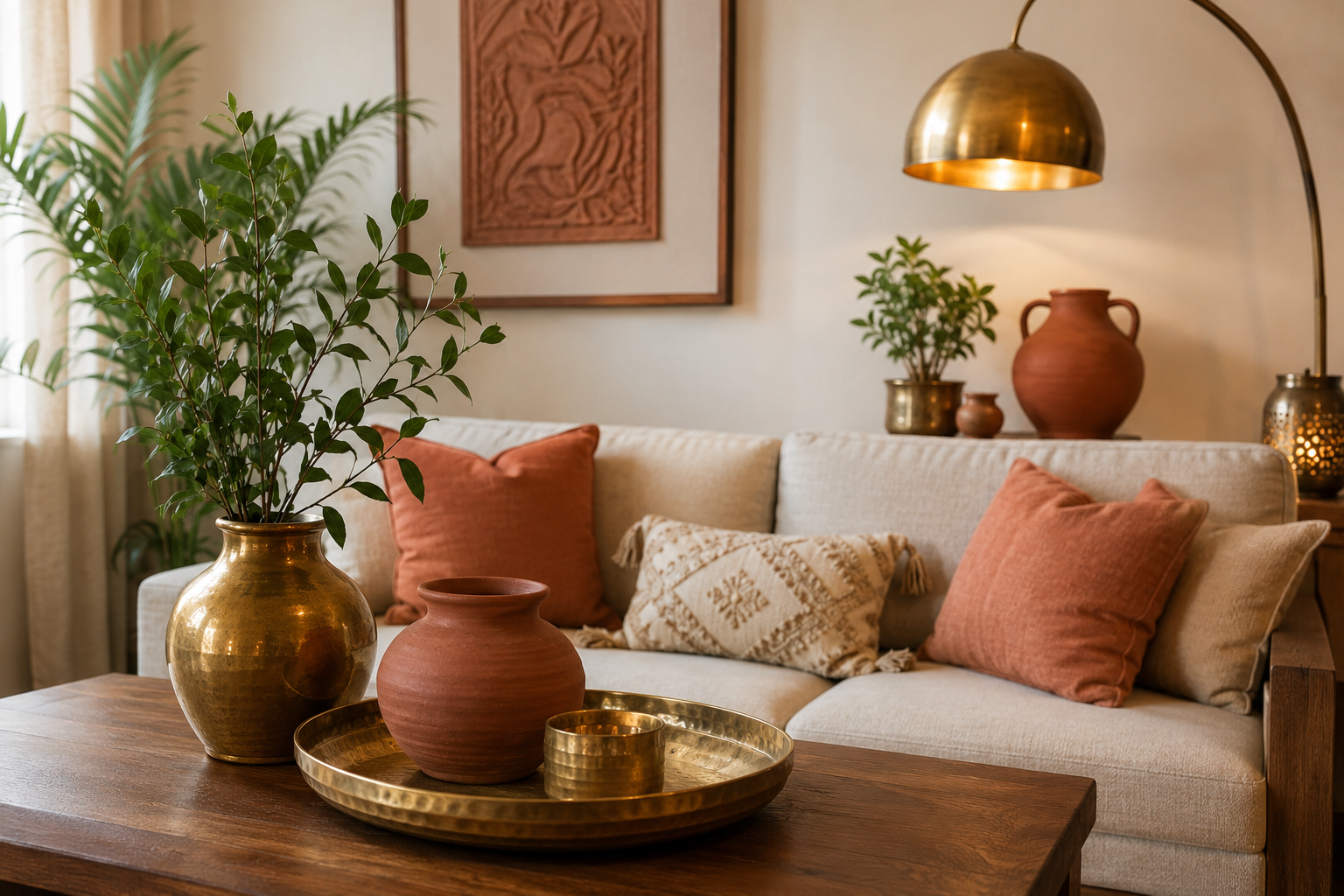
Walk into a high-end hotel lobby in Milan, browse a luxury furniture collection at Maison & Objet in Paris, or scroll through the Instagram feed of a celebrated New York interior designer and you’ll notice something unmistakably familiar. The hand-blocked prints. The jali-inspired screens. The deep ochres and terracotta palettes. The geometry that somehow feels both ancient and futuristic.
India’s design DNA is quietly and increasingly loudly rewriting the world’s visual story.
This isn’t a trend. It’s a reckoning. The global design community is waking up to something that Indian architects, craftspeople, and artists have known for centuries: that Indian aesthetics carry an extraordinary depth of meaning, material intelligence, and spatial wisdom that speaks across cultures, centuries, and contexts.
What We Mean by “Indian Aesthetics”
Before diving into the global stage, it helps to ground the conversation. Indian aesthetics aren’t monolithic; they span millennia and geographies, from the cave paintings of Ajanta to the precision stonework of Hampi, from the ikat looms of Pochampally to the white plaster geometry of Ahmedabad’s havelis.
At its philosophical core, Indian aesthetics are rooted in the concept of rasa, the idea that art and space should evoke a specific emotional or spiritual state in the viewer. This isn’t decoration for decoration’s sake. It’s designed with intentionality, where every element serves a purpose beyond the visual.
Key traditions that carry this philosophy into the design world include:
- Vastu Shastra — India’s ancient spatial science, aligning architecture with natural forces
- Mughal design — a high-water mark of geometric intricacy, garden planning, and material luxury
- Temple architecture — arguably the world’s most sophisticated exploration of sacred geometry
- Regional craft traditions — from Rajasthani blue pottery to Kerala’s laterite architecture
How Indian Design Is Making Its Mark Globally
The Architecture Conversation
In the international architecture scene, the influence of Indian spatial thinking has moved well beyond surface ornament. Firms like Morphogenesis and Sanjay Puri Architects have brought India’s climate-responsive design logic, deep overhangs, courtyard typologies, jaali screens to global award stages.
The jaali, in particular, has had a remarkable second life. What began as a pierced stone screen in Mughal-era palaces is now reimagined in perforated aluminium, laser-cut wood, and parametrically designed concrete facades across projects in Dubai, Singapore, and London. It solves a universal problem of shade, privacy, and ventilation while delivering a visual richness that modern minimalism often lacks.
Zaha Hadid Architects cited Indian fractal geometry as a structural and visual influence in several projects. The recursive self-similar patterns found in South Indian temple gopurams share a mathematical kinship with the computational design methods used in contemporary parametric architecture, a connection that researchers at institutions like IIT Bombay have been exploring for years.
Interior Design and the Global Luxury Market
Luxury interior design has become one of the most visible stages for Indian aesthetic influence. The global appetite for Indian craft handwoven textiles, hand-hammered metalwork, hand-painted ceramics reflects a broader counter-movement against mass production.
Brands like Hermès, Kelly Wearstler, and Roman and Williams have all incorporated Indian artisanal techniques or motifs into their work. Jaipur Rugs, an Indian company that connects rural artisans with global design markets, now supplies to some of the world’s most prestigious residential and hospitality projects. Their weavers, most of them women in rural Rajasthan, are now co-creating collections with European designers.
This is more than trade. It’s a genuine aesthetic exchange that’s changing how luxury is defined.
Indian Colour Philosophy Meets Contemporary Palettes
Indian colour sensibility is one of its most exportable qualities. The ability to layer saffron with indigo, to place a deep pomegranate red next to a dusty rose this chromatic confidence has long been seen as too bold for Western interiors. That’s changing fast.
Colour forecasters at Pantone, WGSN, and the Paint & Colour industry have repeatedly drawn from Indian festive and regional palettes over the past decade. The “warm neutrals” movement sweeping global interiors right now terracottas, raw umbers, sun-bleached ochres has deep roots in Indian vernacular architecture, from the mud walls of Kutch to the laterite buildings of Goa.
Expert Insight: What This Shift Really Means
Architect and design educator Brinda Somaya has written extensively about the need to read Indian design not as an “influence” but as a primary source. Her argument is compelling: Indian architecture never separated function from meaning. Every spatial decision, the direction a door faced, the height of a threshold, the depth of a verandah carried cultural, climatic, and philosophical intent.
As global architecture grapples with climate change, overcrowded cities, and the mental health implications of our built environments, these integrated approaches are more relevant than ever. The verandah, for instance, isn’t just a transitional space. It’s a thermal buffer, a social zone, and a psychological decompression chamber all in one.
Similarly, Vastu Shastra is gaining serious academic attention beyond India’s borders. Researchers are finding meaningful overlaps between Vastu’s orientation principles and bioclimatic design guidelines not because one borrowed from the other, but because both respond to the same physical realities of sun, wind, and human well-being.
India’s Craft Traditions as Living Design Innovation
One of the most under-told stories in global design is how Indian craft traditions are not relics; they are living, adaptive, innovative systems.
The Bidri metalworkers of Bidar, the blue potters of Jaipur, the weavers of Varanasi these are not artisans frozen in time. They are constantly negotiating between tradition and contemporary demand, developing new forms, new applications, and new material languages. When a Varanasi weaver starts translating a Mondrian painting into a Banarasi motif for a Japanese fashion house, something culturally significant is happening.
Design institutions like the National Institute of Design (NID) in Ahmedabad have been critical connectors in this space creating frameworks where craft knowledge meets design education, and where Indian aesthetic intelligence is given the intellectual scaffolding it deserves.
Future Trends: Where Indian Aesthetics Are Headed
The next decade promises an even deeper integration of Indian design thinking in global practice. Here’s what to watch:
Parametric meets traditional geometry. The fractal logic of Indian temple architecture is increasingly being studied as a computational framework. Expect more buildings that use algorithmic design inspired by Dravidian and Nagara architectural grammar.
Craft-tech hybrids. 3D printing and CNC fabrication are being used to scale traditional Indian motifs without losing their character. Studios like Phantom Hands and Tiipoi are already doing this beautifully.
Biophilic design with Indian roots. The Indian relationship with nature expressed in stepwells, temple tanks, and garden typologies aligns powerfully with the global biophilic design movement. Expect Indian water architecture to emerge as a major reference point.
Spiritual and wellness design. As global architecture increasingly incorporates mindfulness and wellness programming, Indian traditions of sacred space design from ashram layouts to the proportional systems of the Manasara will become serious reference points for designers worldwide.
Indian designers on global platforms. Studios like Studio Lotus, Abraham & Thakore, and Rooshad Shroff are already building international profiles. The next generation of Indian design voices is more globally connected, more confident in its Indian identity, and more articulate about it than ever before.
Conclusion
The world isn’t just discovering Indian aesthetics. It’s catching up to them. What India has developed over thousands of years, a design language that integrates climate, craft, spirituality, community, and beauty into a coherent whole is precisely what the global design conversation is desperately searching for.
For Indian architects, designers, and design students, this moment carries both an opportunity and a responsibility. The opportunity: to present Indian aesthetic knowledge not as a regional curiosity but as a universal design intelligence. The responsibility: to do so with rigour, with credit to its origins, and with the depth it deserves.
The world is listening. India has a lot to say.
FAQs
How is Indian aesthetics different from general “Asian” design influences?
Indian aesthetics have a distinct philosophical foundation rooted in concepts like rasa (emotional resonance), vastu (spatial alignment), and the integration of craft, spirituality, and climate response. This sets it apart from East Asian or Southeast Asian design traditions, which have their own separate philosophical systems. Indian design’s specific material culture from handwoven textiles to carved stone also gives it a tactile and regional character that is uniquely identifiable.
Are Indian design elements just used as surface decoration in global projects, or is the influence deeper?
Both exist. Surface-level borrowing using Indian motifs as wallpaper or decorative accents has long been common and, when done without context or credit, is rightfully critiqued. However, the more substantive influence is growing: architects are studying Indian spatial logic for climate response, urban planners are revisiting Indian stepwell typologies for water management, and luxury brands are building genuine long-term partnerships with Indian craft communities.
How can young Indian designers contribute to this global conversation?
By knowing their own heritage deeply before translating it. The most powerful contributions come from designers who understand not just aesthetically but intellectually the systems behind Indian design traditions. Studying at institutions like NID or CEPT, apprenticing with craft communities, and engaging with the academic literature on Indian architectural history are all starting points. The global design world doesn’t need Indian aesthetics watered down. It needs them full-strength.