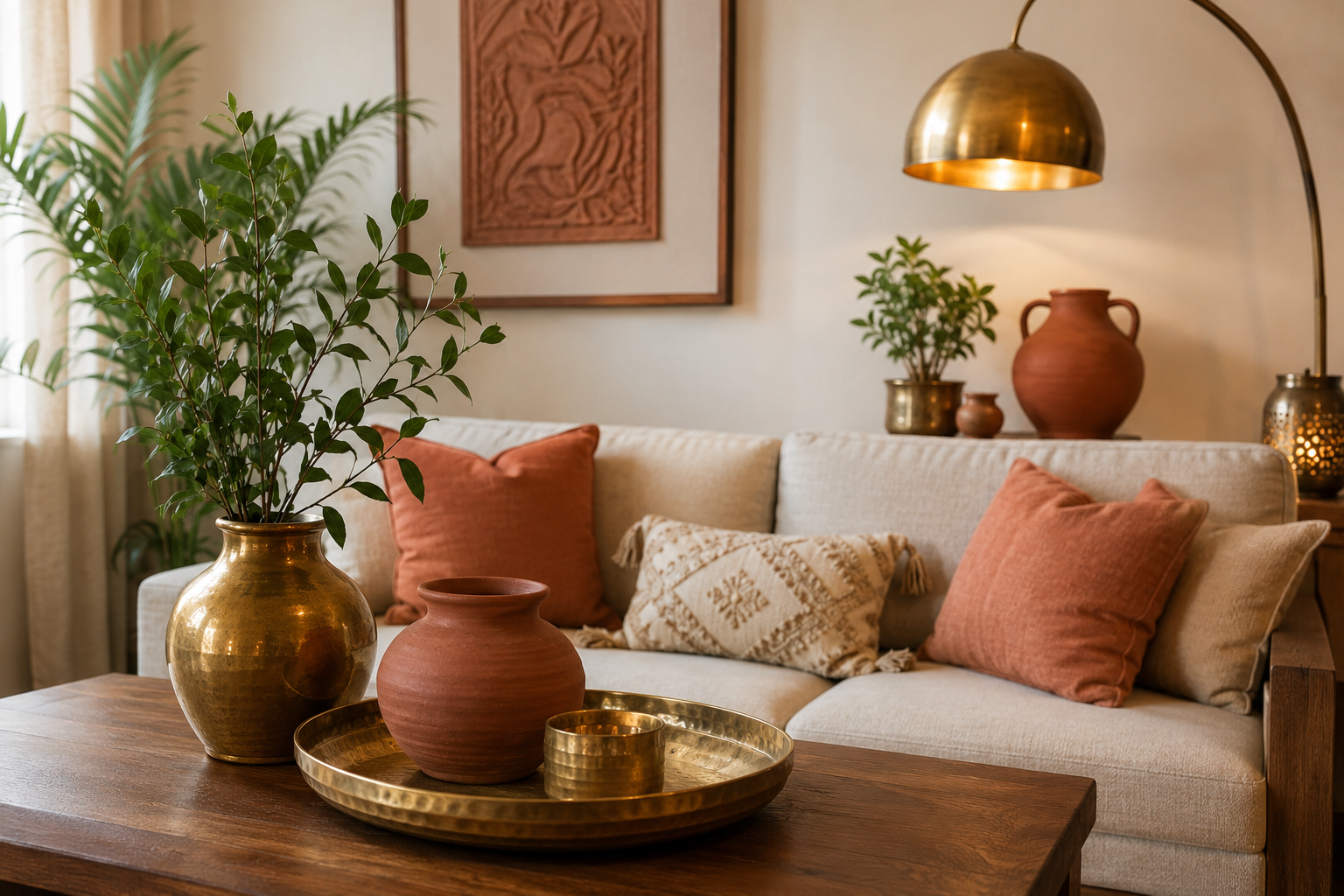
There’s a particular feeling you get the moment you step into a well-designed luxury resort lobby warm, grounded, effortlessly elevated. The kind of space that makes you exhale. Chances are, whether you noticed it or not, brass and terracotta had something to do with it.
These two materials have quietly taken over the most celebrated interiors of the decade. From the earthy lounges of boutique resorts in Rajasthan to the curated residences featured on Design Unfiltered, brass and terracotta have proven that warmth is the new luxury. And the best part? You don’t need a five-crore budget to bring that resort feeling into your own living room.
In this article, we’re breaking down five precise, designer-approved styling tricks to help you use brass and terracotta in a way that feels intentional, elevated, and unmistakably premium.
Why Brass & Terracotta? The Design Psychology Behind the Trend
Before we get into the tricks, it’s worth understanding why this combination works so well.
Terracotta — derived from the Latin for “baked earth” has been used in Indian architecture and craft for millennia. From the temple friezes of Bishnupur to the vernacular pottery of Khurja, it carries deep cultural memory. Brass, similarly, is woven into Indian domestic life. Both materials evoke a sense of rootedness, of handcraft, of something that was made with intention.
From a design psychology standpoint, warm earth tones like terracotta reduce perceived stress and create a sense of enclosure and safety which is exactly what a resort interior is engineered to deliver. Brass, with its reflective warmth, adds luminosity without the cold detachment of chrome or steel. Together, they create what designers call “thermal visual comfort” a space that feels warm before you’ve even touched anything.
According to recent reports from the Indian luxury real estate sector, premium homeowners increasingly prefer materials that blend global aesthetics with local craft identity. Brass and terracotta sit perfectly at that intersection.
Anchor the Room with a Terracotta Accent Wall — but Do It Right
The most common mistake designers see is homeowners painting an entire room terracotta and wondering why it feels like a clay oven. The trick is restraint.
Choose a single architectural wall ideally the one behind your main seating or the fireplace wall and treat it as your canvas. Instead of flat paint, consider:
- Lime wash or Venetian plaster in a terracotta palette for depth and texture
- Handmade terracotta tile cladding in a stacked or running bond pattern
- Exposed brick tinted with a warm ochre wash
The wall becomes an anchor everything else in the room orbits around it. This is a technique commonly used in hospitality design at properties like Sujan Rajmahal Palace in Jaipur, where a single textured wall creates an entire atmospheric narrative.
Design Unfiltered Insight: Pair this with indirect cove lighting above the wall. Warm white LEDs (2700K) will make the terracotta surface glow in the evening, replicating that resort-lounge ambiance precisely.
Use Brass as a Visual Connector, Not Just Decoration
Brass accessories scattered randomly around a room look like a hardware store exploded. What separates a luxury interior from an amateur attempt is the concept of “visual threading” using brass strategically so the eye moves through the space in a deliberate path.
Here’s how to apply it:
- Brass coffee table legs + brass pendant light + brass door handles — three points of brass that form a triangle, guiding the eye across the room
- Keep all your brass finishes consistent: either all brushed antique brass or all polished — never mix
- Use brass to frame, not fill: a brass-edged mirror, a brass-trimmed bookshelf, a brass-legged side table are all framers
The key principle is that brass should catch light, not demand attention. In the most sophisticated resort interiors think Aman or Six Senses properties brass is almost always present, but you rarely notice it consciously. You just feel the warmth.
In India’s climate, unlacquered brass develops a beautiful patina over time. Several designers at the forefront of Indian luxury residential work actually prefer this natural aging it aligns with the “wabi-sabi meets Indian craft” aesthetic that is gaining significant traction in premium design circles.
Layer Textures, Not Just Colors
A resort living room never feels flat. It’s always textural there’s something rough next to something smooth, something matte next to something reflective.
The brass-terracotta palette invites you to play with this brilliantly:
- Terracotta cushion covers in handloom cotton against a smooth linen sofa
- Rough-hewn terracotta vases next to polished brass candle holders
- Jute or sisal rugs anchoring a space with brass-legged furniture above
This layering approach is rooted in the principle of “material contrast” a concept taught in architecture schools but rarely applied with confidence in residential interiors. When two materials with contrasting textures sit side by side, each one makes the other look richer.
For Indian homes specifically, this is an opportunity to incorporate traditional craft Bidri brass inlay work from Karnataka, Longpi black pottery from Manipur used alongside terracotta pieces to create something that is globally refined but unmistakably rooted.
Get the Lighting Right This Is Non-Negotiable
You could have the most perfectly curated brass and terracotta living room, and cold, flat lighting will destroy it entirely.
Resort interiors invest heavily in lighting design for a reason: it is the single most transformative element in any interior space. For a brass-terracotta living room, the rules are:
- No cool white lights (4000K+) — they make terracotta look muddy and brass look cheap
- Warm white (2700K–3000K) is your baseline for all ambient lighting
- Use multiple light sources at varying heights: floor lamps, pendant lights, table lamps, and cove lighting — never rely on a single overhead source
- Brass pendant lights and sconces aren’t just décor — they become light sources that multiply the warmth in the room
A particularly elegant trick used in hospitality lighting design is to place a warm-toned table lamp behind a terracotta ceramic piece so the light glows through or around it. The effect is subtle and deeply atmospheric.
Sustainability Note: All of this can be achieved with energy-efficient LED sources today. Warm-tone LEDs have evolved dramatically; there’s no longer any trade-off between sustainability and ambiance.
Edit Ruthlessly Luxury Is Restraint
This is perhaps the most important trick, and the hardest one for homeowners to execute: less is more.
A resort living room feels luxurious partly because it is curated to a ruthless degree. Every object earns its place. Nothing is there “just because.” In the brass-terracotta palette, the temptation is to pile on every warm-toned object you own. Resist it.
A practical editing framework:
- The Rule of Three: In any vignette (a coffee table arrangement, a shelf display), use no more than three objects. One terracotta, one brass, one natural element (wood, stone, dried botanicals)
- Negative space is a design element: Empty wall, an uncluttered corner, a bare table surface — these are not failures of decoration, they are intentional breathing room
- Every cushion, throw, and rug should earn its place by adding texture, comfort, or colour without competing with the material story of brass and terracotta
This principle of “curated minimalism in warmth” is something covered extensively in Design Unfiltered’s features on luxury Indian residences — homes that feel both rich and restful, never cluttered.
What Leading Indian Interior Designers Say
Designers working on high-end residential and hospitality projects across Mumbai, Delhi, and Bengaluru consistently point to the same shift: clients no longer want their homes to look “Western luxury.” They want spaces that feel globally refined but deeply Indian in material sensibility.
Brass and terracotta are uniquely positioned to deliver this. They are materials that carry cultural weight in India present in ritual, in craft, in architecture but when handled with contemporary design intelligence, they translate into a language that is completely current and premium.
The material story, when told well, does not need to shout.
Future Trends: Where Brass & Terracotta Are Headed
The next evolution of this palette in Indian design is moving toward:
- Micro-textured terracotta surfaces — tiles with subtle geometric relief patterns inspired by classical Indian motifs, produced by contemporary craft studios
- Recycled and reclaimed brass used in custom furniture and light fittings, aligning with the circular economy values increasingly demanded by premium clients
- Biophilic integration — terracotta planters and brass plant stands built into the architectural language of the room, not added as afterthoughts
- Smart home integration with warm aesthetics — concealing technology behind brass grilles and terracotta panels so the digital and the artisanal coexist without conflict
As covered in multiple features on Design Unfiltered, the future of luxury Indian interiors is not about importing foreign aesthetics, it’s about elevating the indigenous with precision and confidence.
Conclusion
Brass and terracotta are not a trend. They are a design language one that India has spoken for centuries and that the world is only now catching up to.
The five tricks outlined here, the textured accent wall, brass as a visual connector, material layering, warm lighting, and the discipline of restraint are not complex. They are, however, deliberate. And deliberateness is what separates a luxury resort interior from an ordinary living room.
Apply even two or three of these principles consistently, and your living room will stop being a place you pass through. It will become a place you want to stay in.
FAQs
Can brass and terracotta work in a small living room without making it feel dark or heavy?
Absolutely. The key is balancing the warmth with natural light and lighter neutrals — off-white, sand, or warm grey on the majority of surfaces. Use terracotta and brass as accent layers rather than dominant tones, and ensure your lighting is layered and warm. Small spaces benefit enormously from brass’s reflective quality, which bounces light and adds perceived depth.
What are some affordable ways to introduce brass and terracotta in a rental home?
Start with what you can carry out: terracotta pots, brass-toned light fixtures (many affordable options are available through Indian craft markets and design e-commerce platforms), textiles in terracotta tones, and a terracotta-coloured throw or cushion set. Removable wallpaper in terracotta texture is another excellent option for renters. The principles of visual threading and restraint apply at every budget level.
How do I prevent a brass and terracotta room from looking dated or “too traditional”?
The risk of looking dated usually comes from over-reliance on one reference — don’t make it look like a 1990s Indian living room. The antidote is contemporary form language: clean-lined furniture, minimal clutter, and modern proportions. Let the materials carry the warmth and cultural reference while the forms remain current. Think of it as a conversation between craft heritage and contemporary design — that tension is precisely what makes it feel sophisticated rather than nostalgic.