Bharat Mandapam: India’s Global Convention Centre
“Bharat Mandapam is a world-class convention centre located at Pragati Maidan in New Delhi. It is used to host major national and international events such as the G20 Summit, exhibitions, conferences, and cultural programs. The building represents a unique blend of Indian heritage and modern infrastructure, showcasing India on a global stage..”
Bharat Mandapam doesn’t feel like just another convention centre. The moment you approach it, something feels different because its more deliberate in its presence. This is a building that has something to say. It is, at its heart, a conversation between India’s past and its future.
The brief from Prime Minister Modi was clear from the start: create an iconic landmark with Indian roots, a “window to India” that reflects the nation’s crafts, culture, and diversity. Not a building that borrows Western grandeur and slaps Indian motifs on top, but something that genuinely grows from Indian soil. That’s a harder brief than it sounds, and the way architect Hafeez Contractor and his team answered it is worth paying attention to.
The Idea Behind the Building
The starting point was the mandapa which is the ancient pillared hall found in temples and royal courts across India, where people gathered to exchange ideas, debate philosophy, celebrate festivals, and conduct the business of community life. It was never just a room. It was a space with intention meant to be open, democratic, designed for many voices at once.
That idea is what quietly shapes everything at Bharat Mandapam. The scale, the openness, the way the building draws you inward rather than overwhelming you from outside and it all traces back to this ancient prototype. Taking a thousands-of-years-old spatial idea and making it work for G20 summits and global conventions is no small thing.
What You See From the Outside
The exterior makes its statement confidently. Stone and copper-toned surfaces wrap the structure, and if you look closely enough, they are covered in patterns drawn from India’s deep well of art and geometry. These aren’t decorative afterthoughts applied at the end to tick a cultural box. They are load-bearing ideas. Motifs inspired by traditions like Warli art, geometric temple carvings, and classical Indian textile patterns are woven into the skin of the building, grounding it in cultural memory while keeping its expression unmistakably contemporary.
And then there is the Nataraja.
Standing at the entrance, 28 feet tall and weighing 18 tonnes, the bronze statue of the dancing Shiva stops you in your tracks. This is not an ornament. Nataraja is one of the most profound images in Indian philosophy where the cosmic dancer who holds creation and destruction in perfect balance, whose rhythm underlies the universe itself. Placing him at the threshold of a building meant to host the world’s conversations is a deliberate act of meaning. It tells you, before you’ve even stepped inside, what kind of building this is trying to be.
Stepping Inside
Inside, the architecture shifts register from symbolic to powerfully functional. Vast, column-free halls stretch out with a confidence that only becomes clear when you realise how technically demanding that kind of open span actually is. Long axial corridors create a sense of procession and direction. Layered levels open up views across the complex, giving you a sense of the whole even as you move through the parts.
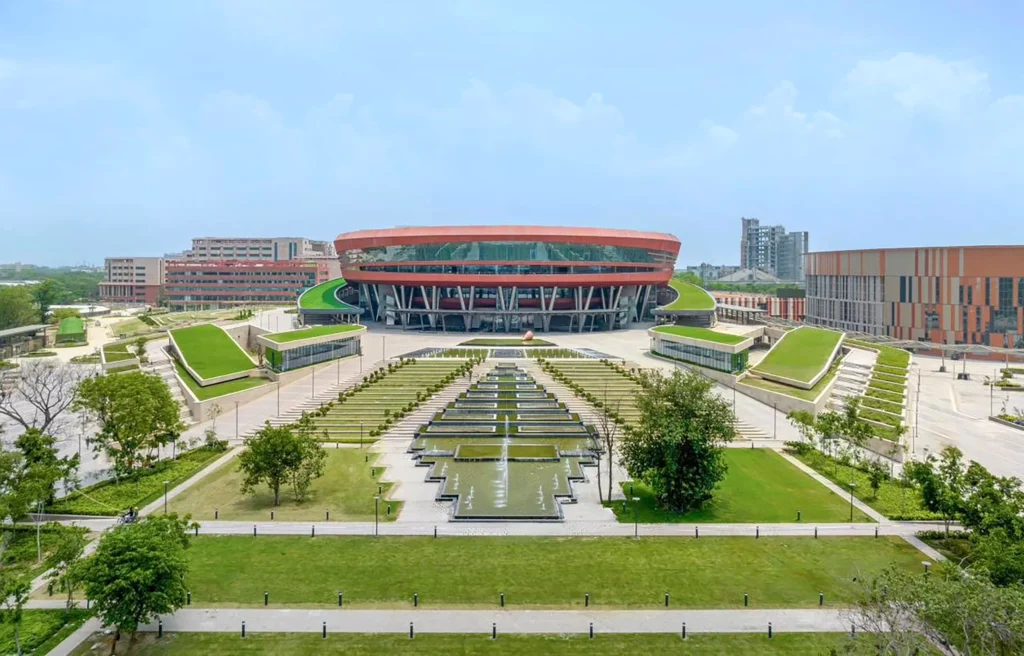
What prevents all this scale from feeling cold or corporate is the detail. Indian materials, warm colours, and a spatial logic rooted in traditional order quietly humanise the experience. The exhibition spaces carry regional craft references where textures and finishes that nod to specific Indian making traditions rather than generic “Indian-ness.” The convention halls are world-class in their technical capability but never feel like they could belong anywhere else on earth. That balance is genuinely difficult to achieve, and Bharat Mandapam achieves it more often than not.
Why It Matters
For a long time, ambitious Indian public buildings faced an unspoken choice: look modern and global, or look traditionally Indian. Bharat Mandapam refuses that choice. It argues, through built form, that the two are not in conflict and that a mandapa can host a G20 summit, that Nataraja belongs at the entrance of a world-class convention centre, that Indian geometry is sophisticated enough to hold its own on any international stage.
That argument matters beyond this one building. It sets a precedent. It tells the next generation of Indian architects that they don’t have to choose between heritage and ambition and that the richest path forward is the one that knows exactly where it comes from.
Bharat Mandapam is not a perfect building. No building this ambitious ever is. But it is a serious one, and in the best moments, a genuinely moving one. It reminds you that architecture, at its most intentional, is never just about shelter or function. It is about who a people understand themselves to be.
For readers interested in exploring more such grounded architectural narratives, platforms like Design Unfiltered continue to document India’s evolving design landscape through real projects, thoughtful analysis, and conversations that go beyond surface-level aesthetics to capture the deeper cultural context of built environments.
FAQs
Bharat Mandapam is inspired by the ancient Indian mandapa, a pillared hall used for gatherings, reimagined for modern global events and conventions.
The convention centre was designed by renowned Indian architect Hafeez Contractor and his team.
The statue of Nataraja symbolizes cosmic balance, representing creation and destruction, aligning with the building’s role as a space for global dialogue.
Bharat Mandapam is located in Pragati Maidan, New Delhi, India.
It uniquely blends Indian cultural elements like Warli art, temple geometry, and traditional materials with cutting-edge engineering and global convention standards.