Time took a bit of a pause when new-age, future-ready architects of the state decided to rethink context, and the future of design at an informal yet insightful dialogue held during Design Unfiltered Conclave, Amritsar. Moving away from superficial markers of wealth, the discussion positioned luxury as something intuitively personal and enduring, rooted in how spaces are lived in rather than merely, materialistically enjoyed. More information lies down here…
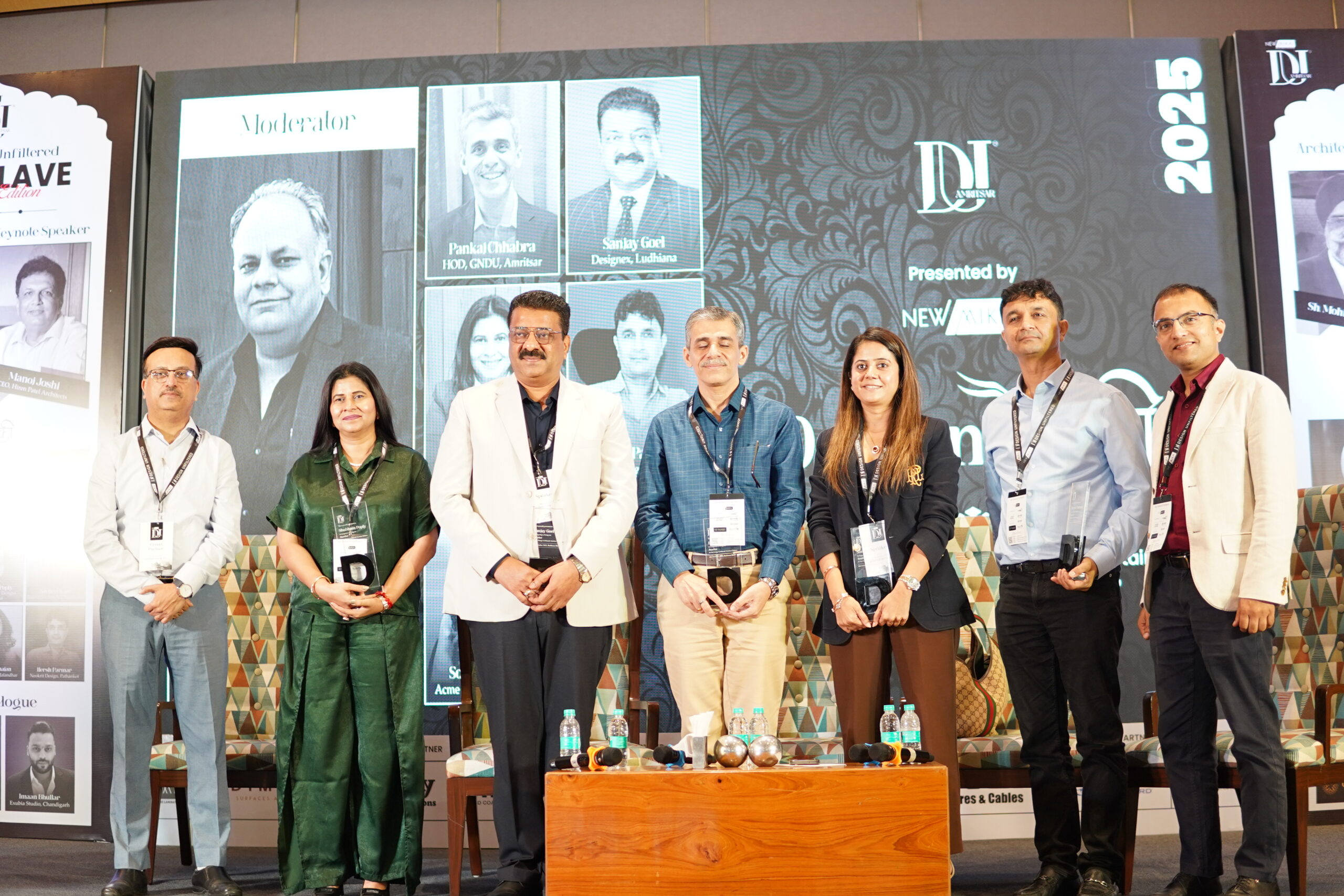
The event was graced by well-known architects and designers of Amritsar and around. Ar Vishal Kakria, Ar Samriddh Aneja, and Ar Imaan Bhullar explored how contemporary practice is redefining luxury—not as excess or ornamentation, but as experience, intention, and longevity. The session was moderated by renowned faces from fraternity, namely Narotam Singh and Praneet Bubber.
The conversation opened with a question posed by Singh: how do you personally define luxury in architecture, and how do you see this definition evolving among young architects in cities like yours?
“Luxury isn’t defined by expensive materials—it’s defined by experience.” — Vishal Kakria
For Ar Vishal, luxury is something to experience. He reflects on how memorable spaces are not defined by materials or finishes alone, but by how they make one feel over time. A truly luxurious space, he suggests, is one that continues to offer comfort and meaning years later. If a design prioritizes visual brilliance over only livability, then its purpose shifts away from the user..Therefore, luxury must be experienced, not just looked at in the form of all things glitz and gold.
“For me, luxury begins with essence and ends with essence.” — Samriddh Aneja
Samriddh Aneja builds on this idea by describing design as a translation of essence into built form. According to him, every project begins with a conceptual core — an intangible quality that guides the design process from sketch to completion. The success of a project lies in its ability to retain that original essence through execution. Luxury, thus, is not an added layer but something embedded within the very foundation of the design process.
“Architecture should be multilingual—spaces should speak differently to different people.” — Imaan Bhullar
The question in the end reached Bhullar, who approaches the topic more analytically, suggesting that architecture should function as a multilingual medium. Spaces, he says, should be open to multiple readings, allowing different users to draw their own meanings and experiences. This way, luxury emerges when a space is able to communicate—when it resonates with its users in a way that feels personal and genuine. Every line drawn carries intent, and every built form becomes an opportunity for interaction and interpretation.
UnFilteredTalk: Regional References of Architecture
Later in the flow, the conversation also highlights the importance of regional context in shaping architectural expression. Cities like Ludhiana, Chandigarh, and Amritsar present distinct cultural and economic conditions that influence client expectations. Ludhiana, with its industrial wealth and global exposure, tends toward more expressive and internationally-influenced architecture. Chandigarh, on the other hand, reflects a more restrained sensibility rooted in its modernist planning legacy, where openness and calm environments are often valued over overt display. Amritsar, experiencing rapid growth driven by tourism, is witnessing a shift toward greater design awareness and experimentation. Across all three contexts, travel and exposure play a significant role in shaping how clients perceive and demand architecture. After all, mustn’t we remember, Punjab equals all things larger-than-life?!
UnFilteredTalk: The Sustainability Soiree!
Later in the talk, sustainability emerges as another buzzing topic or theme (as usual) — because it’s mostly placed opposite luxury. The panelists try to collectively challenge this notion, arguing that the two can coexist beautifully. They suggest that sustainable design can enhance the experience of luxury by allowing a stronger connect with nature and promoting well-being. Landscaping, natural light, and thoughtful spatial planning become tools for creating environments that feel both responsible and enriching. The emphasis shifts from expensive materials to intelligent choices, demonstrating that true luxury lies in the quality of experience rather than the cost of construction.
UnFilteredTalk: It’s Tech Versus Thought
Technology and its role in the design process form another layer of discussion towards the conclusion of the talk. The discussion remained how despite the growing influence of digital tools, AI platforms, and visual references, all three architects emphasize the continued importance of hand sketching. The initial idea, they argue, must originate from within and find its first expression on paper. Technology serves as a means of development and refinement, but not as a source of creativity in itself. Over-reliance on external references risks diluting originality, making it essential for architects to utilize and rely on their own internal design language, instead of some flawed, formulaic and unreliable technology.
Switching Shifts: Women in Architecture
The dialogue also touches on the evolving role of women in architecture. While the profession has historically been male-dominated, there is a noticeable shift toward greater inclusivity. The architects acknowledge that women are increasingly leading practices and contributing significantly to the field, bringing diverse perspectives and sensitivities to design. They all collectively agree that creativity surpasses gender, and the profession is gradually moving toward a future that is balanced and brings equal opportunities.
Ultimately, the dialogue reveals a generation of architects committed to redefining luxury in meaningful ways. Rather than comparing it with opulence, they advocate for an approach that values genuinity, sustainability, and deeper connection. According to the curated narrative, post the talk — luxury is no longer about what is immediately visible, but about what is felt, remembered, and kept over time.